
The AI Behind Nothron Neural Headshot Generator: Insight Face, LoRA/DreamBooth and the 78,125 Photo Production Pool
How does an AI headshot generator work? Nothron's architectural pipeline: Insight Face 512D vector, DreamBooth + LoRA fine-tuning, prompt pool with 78,125 photo generation. Get ahead on dating apps, LinkedIn and social media.
ON THIS PAGE
You upload a casual selfie. Ten minutes later, 78,125 professional headshots — all of you — are ready. Sounds like science fiction, but this is what Nothron Neural Headshot Generator does every day for thousands of users. But what actually happens behind the scenes?
In 2026, seeing an AI headshot generator as simply "upload a photo, get results" is like looking at the tip of an iceberg. Beneath the simple interface lies a complex AI pipeline representing the cutting edge of deep learning research. Insight Face face recognition, 512-dimensional identity vector extraction, DreamBooth and LoRA fine-tuning, 78,125 combinatorial prompt generation, and 3-stage quality filtering — all triggered by a single selfie upload.
Quick Summary: This article breaks down Nothron's 4-stage AI pipeline step by step. Stage 1 — Insight Face converts your face into a 512-dimensional mathematical vector. Stage 2 — DreamBooth + LoRA hybrid fine-tuning personalizes the model to recognize you. Stage 3 — Prompt Pool generates 5⁷=78,125 unique headshot combinations across 7 categories. Stage 4 — Cosine similarity threshold, aesthetic scoring, and artifact detection select only the best results. The output: platform-optimized professional headshots ready for Tinder, LinkedIn, Instagram, Bumble, and more.
We previously covered why you should use an AI headshot generator in our advantages article. Here, we dive into how it actually works at the architectural level.
#Who Is This For?
- Dating app users (Tinder, Bumble, Hinge): Curious about the technology behind your profile pictures
- LinkedIn professionals: 71% of recruiters eliminate candidates without a quality profile photo — learn why
- Photographers and developers: See how Stable Diffusion, LoRA, DreamBooth, and Insight Face work together in production
- AI enthusiasts: Understand an end-to-end AI product architecture beyond surface-level explanations
Nothron Neural Headshot Generator is not an ordinary photo upload tool. Behind it are 512-dimensional mathematical identity vectors extracted with Insight Face (ArcFace), finely tuned fine-tuning processes with DreamBooth and LoRA, a dynamic Prompt Pool mechanism, and a massive combinatorial generation engine capable of producing 78,125 different photos.
#Table of Contents
- Overall Pipeline Architecture
- Stage 1 — Face Detection and 512-Dimensional Identity Vector with Insight Face
- Stage 2 — Personalized Fine-Tuning with DreamBooth and LoRA
- Stage 3 — Prompt Pool Mechanism and Dynamic Generation
- Stage 4 — Quality Filtering, Selection and Platform Optimization
- Behind the Scenes: User Journey and Timeline
- Architecture Comparison: Nothron vs Competitors
- The Secret to Getting Ahead of Competitors
- Frequently Asked Questions
- Conclusion
#Overall Pipeline Architecture
Nothron Neural Headshot Generator is designed as an end-to-end AI pipeline. Each stage works in a chain, providing input to the next stage:
User Photo (Selfie / Portrait)
         │
         ▼
┌─────────────────────────────────────┐
│   STAGE 1: Face Detection &       │
│   Identity Vector Extraction      │
│  ┌───────────────────────────────┐  │
│  │ • MTCNN / RetinaFace face    │  │
│  │   detection & landmark       │  │
│  │ • Insight Face (ArcFace)    │  │
│  │   512D identity vector (ID) │  │
│  │ • Face quality assessment    │  │
│  └───────────────┬───────────────┘  │
└──────────────────┼──────────────────┘
                   ▼
┌─────────────────────────────────────┐
│   STAGE 2: Fine-Tuning &          │
│   Adaptation                       │
│  ┌───────────────────────────────┐  │
│  │ • DreamBooth model training   │  │
│  │   from reference photos       │  │
│  │ • LoRA low-rank adaptation    │  │
│  │   matrix creation             │  │
│  │ • S and V* token embedding   │  │
│  └───────────────┬───────────────┘  │
└──────────────────┼──────────────────┘
                   ▼
┌─────────────────────────────────────┐
│   STAGE 3: Prompt Pool &           │
│   Generation                        │
│  ┌───────────────────────────────┐  │
│  │ • 7-category prompt selection │  │
│  │ • Combination: 5⁷ = 78,125   │  │
│  │ • Stable Diffusion XL / SD3  │  │
│  │   batch generation            │  │
│  │ • CFG Scale + Seed variation │  │
│  └───────────────┬───────────────┘  │
└──────────────────┼──────────────────┘
                   ▼
┌─────────────────────────────────────┐
│   STAGE 4: Quality Filtering       │
│  ┌───────────────────────────────┐  │
│  │ • Face identity verification │  │
│  │   (cosine similarity > 0.6)  │  │
│  │ • Aesthetic score analysis   │  │
│  │ • Artifact detection &       │  │
│  │   elimination                │  │
│  │ • Platform optimization      │  │
│  └───────────────┬───────────────┘  │
└──────────────────┼──────────────────┘
                   ▼
         Professional Headshot Output
Now let's examine each stage in depth.
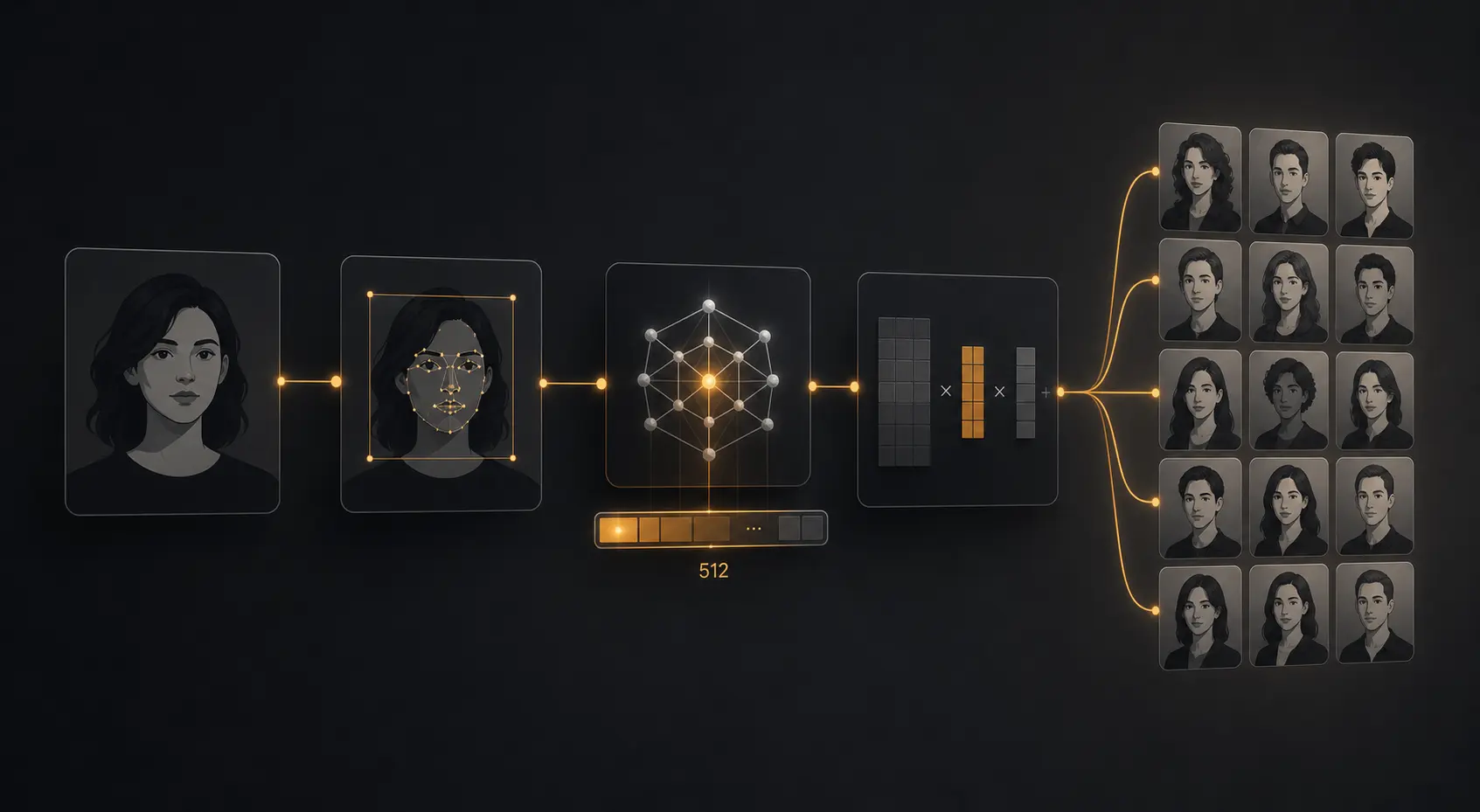
#Stage 1 — Face Detection and 512-Dimensional Identity Vector with Insight Face
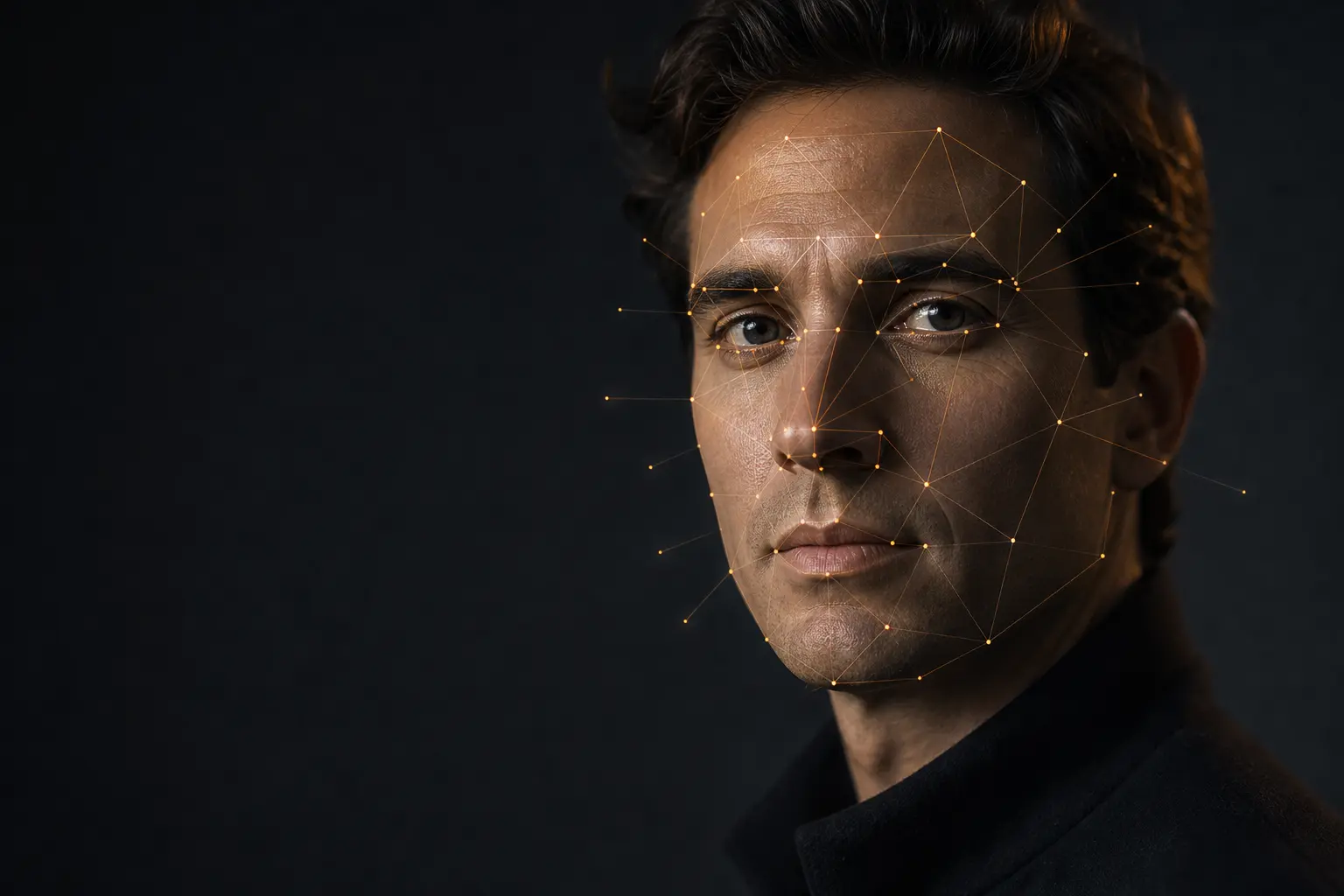
Everything starts with the analysis of the photo uploaded by the user. The first step of the Nothron pipeline is to detect the face in the photo and convert it into a mathematical identity.
#Face Detection: MTCNN and RetinaFace
At the start of the pipeline, we use a two-stage approach for face detection:
- MTCNN (Multi-Task Cascaded Convolutional Networks): A lightweight and fast model for initial scanning. It detects all face regions in the photo and extracts bounding boxes.
- RetinaFace: The second stage that kicks in when higher accuracy is needed. It extracts facial landmarks (eyes, nose, mouth corners) with millimeter precision. RetinaFace performs better than MTCNN especially in challenging poses (profile, tilted angle, low light).
The extracted landmarks are used for face alignment. Each face is normalized to a standard position before being fed to the Insight Face model.
#Insight Face (ArcFace) Embedding Extraction
Once the face is aligned, it is time to convert this face into a mathematical identity. This is where Insight Face comes in.
Insight Face is a groundbreaking open-source project in the field of face recognition. Developed by Microsoft's research team, this project brings together various face recognition models (ArcFace, CosFace, SphereFace, etc.) under a single roof.
Nothron uses the ArcFace model from the Insight Face project.
#ArcFace Loss Function
ArcFace (Additive Angular Margin Loss) is a loss function that directly optimizes the angular distance between face embeddings. Unlike traditional softmax loss, ArcFace:
- Adds Angular Margin: It adds a fixed angular margin (m) to the decision boundary between classes. This margin ensures that different photos of the same person are closer together in embedding space, while those of different people are farther apart.
- Normalizes Embeddings: It L2 normalizes feature vectors and weights, ensuring the loss depends only on angular distance.
- Maximizes Inter-Class Separation: Thanks to the angular margin, the distance between embeddings of different people is maximized.
The mathematical expression of ArcFace is:
L = -(1/N) * Σ log( e^(s·cos(θ_yi + m)) / (e^(s·cos(θ_yi + m)) + Σ e^(s·cos(θ_j)) ))
Where:
- θ_yi: The angle between the correct class and the embedding
- m: Angular margin (typically 0.5)
- s: Scale factor (typically 64)
- N: Total number of samples
ArcFace builds on previous approaches — SphereFace (angular softmax) and CosFace (cosine margin). SphereFace used angular distance but only modified softmax; CosFace added a margin in cosine space but could not fully optimize angular distribution. ArcFace combines the advantages of both and directly optimizes the angular distance — achieving %99.83+ accuracy on the LFW (Labeled Faces in the Wild) benchmark.
#512-Dimensional Embedding Space
The ArcFace model converts each face into a 512-dimensional vector (embedding). This vector numerically represents the person's facial identity:
deformed, bad proportions, duplicate face
🎯 What this means for you: Upload one selfie, get 78,125 different headshots. But you only see the best ones — everything else is filtered out automatically. Corporate for LinkedIn, approachable for Tinder, vibrant for Instagram — all while staying unmistakably you. Learn which style works best for each platform →
#Stage 2 — Personalized Fine-Tuning with DreamBooth and LoRA
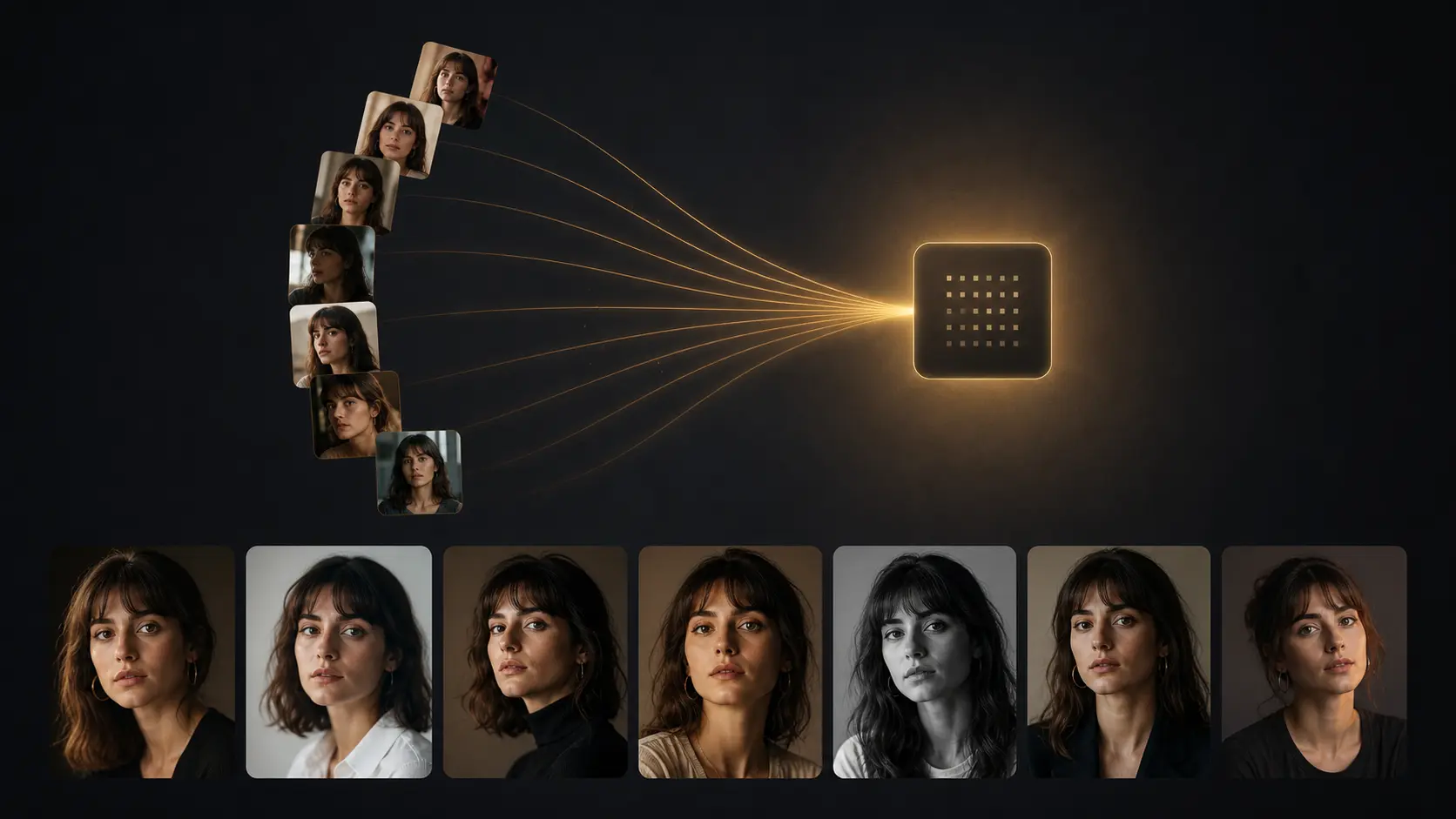
After the face is detected and the mathematical identity vector is extracted, it is time to introduce this identity to the photo generation model. A standard Stable Diffusion model knows the concept of "a human face" but does not know "your face." This is where DreamBooth and LoRA come in.
#DreamBooth: Model Personalization with a Few Photos
DreamBooth is a fine-tuning technique developed by Google Research and Boston University. It fine-tunes the entire Stable Diffusion model to recognize a specific person using just 3-5 photos of that person.
How DreamBooth works:
- Unique Token Assignment: A new token is introduced to the model — for example,
s. This token represents a specific person. - Prior Preservation Loss: An additional loss function is used to protect against catastrophic forgetting, ensuring the model retains its original capabilities. This loss allows the model to learn the "s" token without forgetting the concept of "human."
- Fine-Tuning: All model weights are fine-tuned on the user's photos.
The cost of DreamBooth is high. A full DreamBooth fine-tuning requires:
- Approximately 5-15 GB of GPU memory
- Training time ranging from 5-15 minutes
- 1000-3000 optimization steps
Nothron runs DreamBooth once per user and caches the resulting fine-tuned model weights together with the 512-dimensional identity vector. This way, when the same user wants to create headshots again, the entire pipeline does not need to be re-run.
#LoRA: Efficient Fine-Tuning with Low-Rank Adaptation
DreamBooth's biggest disadvantage is that it changes all model weights. This is costly both in terms of storage (~2-5 GB per user) and time. This is where LoRA comes in.
LoRA (Low-Rank Adaptation) does not fine-tune the full model weights. Instead, it adds low-rank adaptation matrices to the model. These matrices are placed in parallel alongside the original weights, and only these small matrices are trained.
Technical Detail: Let the original model weights be W₀ ∈ ℝ^(d×k). Instead of updating W₀, LoRA uses two low-rank matrices:
W = W₀ + ΔW = W₀ + BA
Where B ∈ ℝ^(d×r), A ∈ ℝ^(r×k) and r ≪ min(d, k). Typically r = 4, 8, or 16.
Advantages of LoRA:
- Size: Only ~5-50 MB adaptation matrix instead of full model (~5 GB)
- Speed: Training time drops to 1-3 minutes
- Flexibility: Multiple LoRA adaptations can be added to the same model
- Swappable: LoRA matrices can be instantly plugged in and removed
#Nothron's Hybrid Approach
Nothron adopts a hybrid approach that uses both DreamBooth and LoRA:
- DreamBooth (First Use): When a user creates headshots for the first time, DreamBooth fine-tunes the entire model to the user's face. This ensures maximum quality and consistency.
- LoRA (Repeat and Variation): In each subsequent headshot generation, one or more LoRA adaptations are added on top of the DreamBooth fine-tuned model. This allows the user to try new styles, expressions, or environments in just a few seconds.
Pipeline LoRA integration works as follows:
User Photo
       │
       ▼
┌──────────────────┐
│  DreamBooth       │  (First use, ~5-10 min)
│  Fine-Tuning      │
└────────┬─────────┘
         ▼
┌──────────────────┐
│  Base Model +   │  (Cached)
│  User Weights    │
└────────┬─────────┘
         ▼
┌──────────────────┐
│  LoRA Adaptation │  (Added per generation)
│  • Style LoRA    │
│  • Light LoRA    │
│  • Expression    │
│    LoRA          │
└────────┬─────────┘
         ▼
┌──────────────────┐
│  Stable Diffusion│
│  Generation      │
└──────────────────┘
Thanks to this hybrid approach:
- Quality: DreamBooth's high-quality personalization
- Speed: LoRA's fast adaptation
- Flexibility: Infinite variation possibilities
- Efficiency: Storage cost kept to a minimum
⏱ Real-world difference: First use takes ~5-10 min for DreamBooth training. But every subsequent headshot generation takes only 3-4 minutes with LoRA adaptation. Competitors like aragon.ai require 10-15 minutes of waiting for every new style. Create your headshot now →
#Stage 3 — Prompt Pool Mechanism and Dynamic Generation
After the model is personalized, it is time to generate thousands of different headshot variations. This is where the Prompt Pool mechanism comes into play.
#Prompt Pool Categories and Variations
The Nothron Prompt Pool is organized into 7 main categories. Each category controls a different dimension of human portrait photography:
- Style (5 variations) —
professional studio,casual lifestyle,corporate,creative editorial,cinematic - Background (5 variations) —
solid white background,urban cityscape,nature landscape,office interior,soft gradient - Clothing (5 variations) —
business suit,smart casual,street style,formal wear,minimalist - Lighting (5 variations) —
soft studio lighting,natural window light,golden hour glow,dramatic Rembrandt,high-key bright - Angle (5 variations) —
straight-on portrait,three-quarter view,profile angle,slightly elevated,eye-level - Expression (5 variations) —
genuine smile,confident gaze,professional composure,warm engaging,approachable - Mood (5 variations) —
warm and friendly,powerful and authoritative,calm and serene,energetic and vibrant,sophisticated and elegant
Each category contains 5 variations, and each variation has its own sub-prompts, negative prompts, and CFG scale values.
#5⁷ = 78,125: Combinatorial Explosion
The power of the Prompt Pool lies in combinatorial multiplication. When 1 variation is selected from each of the 7 categories:
5 × 5 × 5 × 5 × 5 × 5 × 5 = 5⁷ = 78,125
Each combination produces a completely different visual result. This means Nothron can offer each user 78,125 different headshots. Moreover, when you add:
- Seed variations: Different seeds with the same prompt (e.g., 10 seeds) → 781,250
- CFG Scale variations: Different CFG scale values (7.0, 7.5, 8.0, 8.5, 9.0) → 390,625
- Model variations: SDXL, SD3, Fine-tuned variants → millions
...theoretically, an unlimited number of unique headshots can be generated.
#Combination Tree: From a Single Selfie to 78,125 Variations
To visualize how the Prompt Pool works, let's examine an example combination tree. The diagram below shows how choices in 7 categories branch from a user's selfie, with each branch producing a new headshot variation:
                         ┌─ Style: Professional Studio ──┐
                         │                              │
                         │  ┌─ Background: White ──┐     │
                         │  │                      │     │
                         │  │  ┌─ Clothing: Suit ─┐│     │
                         │  │  │                  ││     │
                         │  │  │  ┌─ Light: Soft ─┐││     │
                         │  │  │  │              │││     │
                         │  │  │  │  ┌─ Angle: ──┐│││     │
                         │  │  │  │  │ Straight  ││││     │
                         │  │  │  │  └───────────┘│││     │
                         │  │  │  │  ┌─ Expr.: ──┐│││     │
                         │  │  │  │  │ Confident ││││     │
                         │  │  │  │  └───────────┘│││     │
                         │  │  │  │  ┌─ Mood: ───┐│││     │
                         │  │  │  │  │ Authorit. ││││     │
                         │  │  │  │  └───────────┘│││     │
                         │  │  │  └───────────────┘││     │
                         │  │  └───────────────────┘│     │
                         │  └───────────────────────┘     │
                         │                              │
                         │  77,624 Other Combinations... │
                         └──────────────────────────────┘
                                      │
                               ┌──────┴──────┐
                               ▼             ▼
                       LinkedIn Headshot  Tinder Headshot
                        (Combination #1)   (Combination #42,917)
Each leaf node is a unique headshot formed by combining 7 prompt tokens selected from 7 categories:
Example Combination #1 (LinkedIn):
  Style: Professional Studio
  + Background: Solid White Background
  + Clothing: Business Suit
  + Lighting: Soft Studio Lighting
  + Angle: Straight-On Portrait
  + Expression: Confident Gaze
  + Mood: Powerful & Authoritative
  = Professional, trustworthy, business-appropriate headshot

Example Combination #42,917 (Tinder):
  Style: Casual Lifestyle
  + Background: Nature Landscape
  + Clothing: Smart Casual
  + Lighting: Golden Hour Glow
  + Angle: Three-Quarter View
  + Expression: Genuine Smile
  + Mood: Warm & Friendly
  = Approachable, natural, dating app optimized headshot
All 78,125 combinations preserve the same facial identity (512-dimensional vector); only the environmental and aesthetic parameters change. This ensures all variations look like you, not a different person.
#Style Scene — NLP Prompt Expander
Nothron's Prompt Pool is not just a static template list. It is also supported by an NLP-based prompt expander (Style Scene):
When a user requests "a professional LinkedIn headshot," the system follows these steps:
- Keyword Extraction: The user's input is analyzed with NLP
- Category Mapping: Keywords are mapped to prompt pool categories
- Dynamic Prompt Creation: Selected variations from matching categories are combined
- Negative Prompt Addition: Unwanted features (blurry, low quality, distorted) are added as negative prompts
Example of a constructed prompt:
professional portrait photo of a s person wearing a business suit,
soft studio lighting, confident gaze, straight-on angle,
solid light gray background, warm and friendly mood,
professional headshot photography, 4K, highly detailed,
shot on Hasselblad, natural skin texture, photorealistic
Negative prompt:
blurry, low quality, distorted face, bad anatomy,
extra limbs, fused fingers, cartoon, illustration,
oversaturated, overexposed, makeup, plastic skin,
deformed, bad proportions, duplicate face
#Stage 4 — Quality Filtering, Selection and Platform Optimization
Every generated photo goes through a strict quality control process before being shown to the user.
#Face Identity Verification
The first and most critical filter: Does the face in the generated photo resemble the user's original face?
- A 512-dimensional vector is extracted from the generated headshot using Insight Face
- Cosine similarity is calculated against the original photo's 512-dimensional vector
- Cosine similarity < 0.6 → PHOTO IS ELIMINATED
This filter guarantees facial identity preservation. Every photo Nothron produces reflects your face — no imaginary or deformed faces resembling someone else are generated.
#Aesthetic Score Analysis
The second filter evaluates the aesthetic quality of the photo:
- LAION Aesthetic Predictor: Calculates the photo's aesthetic score on a scale of 1-10
- Threshold: Photos with a score below 7.0 are eliminated
- Artifact Detection: AI artifacts (abnormal fingers, three eyes, broken teeth, etc.) are detected with a detector model
The remaining photos are sorted by aesthetic score, and the highest-scoring ones are presented to the user.
#Platform-Based Optimization
The final stage optimizes the selected photo for the target platform:
- Tinder — 640×640 px, JPEG (QF 85) — Face ratio %60-70, background blur
- LinkedIn — 768×768 px, JPEG (QF 90) — Color temperature adjustment, contrast optimization
- Instagram — 1080×1080 px, PNG — Circular crop compatibility, vibrant colors
- Bumble — 1200×1200 px, JPEG (QF 95) — High resolution, natural tones
- Hinge — 1080×1080 px, JPEG (QF 90) — Story-focused composition
- Facebook — 720×720 px, JPEG (QF 85) — Balanced exposure, wide color gamut
- Upwork/Fiverr — 400×400 px, JPEG (QF 85) — Professional expression, trustworthy look
Each platform has its own optimization profile that includes not just size but also color space, sharpness, contrast, and composition parameters.
📱 Practical difference: The same headshot can be shared on Tinder, LinkedIn, and Instagram — automatically optimized for each platform. Read our LinkedIn profile photo guide to see what recruiters look for →
#Traditional Photographer vs AI Headshot Generator
Still thinking "I should just go to a professional photographer"? Here is a realistic comparison:
Cost:
- Professional photographer: $100-$500 (session + outfit + makeup + travel)
- Nothron AI: One-time fee, unlimited generation
Time:
- Professional photographer: Booking + shoot + selection + retouching = 3-7 days
- Nothron AI: 10 minutes first use, 3-4 minutes repeat
Variety:
- Professional photographer: 1 style, 1 setting, 1 outfit — 50-100 photos per session
- Nothron AI: 78,125 combinations, 7 platform optimizations
Consistency:
- Professional photographer: Different lighting, different expression every session
- Nothron AI: 512D vector ensures all photos preserve the same facial identity
Re-shoot:
- Professional photographer: New booking, new fee
- Nothron AI: One click, new style, no extra cost
📸 Note for photographers: Nothron does not replace photographers. It is a tool that amplifies a photographer's portfolio in the digital space. Photographers can expand their services by offering digital headshot variations to clients through Nothron.
#Behind the Scenes: User Journey and Timeline
Let's look at all this technical infrastructure from a user's perspective. What happens second by second behind the scenes when you upload a selfie?
#First Use (Cold Start — DreamBooth)
When a user uploads a photo to Nothron for the first time:
  ╔═══════════════════════════════════════════════════════════════╗
  ║                    USER JOURNEY                               ║
  ║                    (First Use)                                ║
  ╚═══════════════════════════════════════════════════════════════╝

  T+0s     ─── User uploads photo
             │
             ▼ On screen: "Analyzing photo..."
  T+1s     ─── MTCNN + RetinaFace face detection
  T+2s     ─── Insight Face (ArcFace) 512D vector extraction
             │
             ▼ On screen: "Preparing your AI model..."
  T+3s     ─── DreamBooth fine-tuning begins (background)
             │
             ▼ On screen: "Training your custom model..."
  T+30s    ─── ~150 of 1000 steps completed
  T+1min   ─── ~300 steps
             │
             ▼ On screen: "Model training in progress..."
  T+3min   ─── ~900 steps
  T+5min   ─── DreamBooth completed (1500 steps)
             │
             ▼ On screen: "Generating your photos..."
  T+5min30s ─ 5 × LoRA adaptations added (Style, Light, Expression, Angle, Background)
  T+5min35s ─ 5 variations from 7 categories = 78,125 combinations
             ├── Batch 1: 500 photos generation begins
             ├── Batch 2: 500 photos...
             ├── ... (parallel GPU processing)
             │
             ▼ On screen: "Selecting best results..."
  T+8min    ─── All 78,125 photos generated
  T+8min05s ─ 78,125 × Insight Face verification (cosine similarity)
  T+8min30s ─ Elimination: similarity < 0.6 → removed
  T+8min45s ─ LAION Aesthetic Score calculation
  T+9min    ─── Artifact detection and final elimination
             │
             ▼ On screen: "Here are your custom headshots!"
  T+9min15s ─ Top 10 highest-scoring photos presented to user
What the user sees on screen: A simple loading bar and progress status. The entire complex pipeline runs in the background — the user simply receives results within 5-10 minutes.
#Repeat Use (Cache Hit — LoRA Only)
When the same user wants to create new headshots later:
  T+0s     ─── User clicks "Create New Headshot" button
  T+1s     ─── 512D identity vector loaded from cache
  T+2s     ─── DreamBooth weights loaded from cache
             │
             ▼ On screen: "Applying your custom styles..."
  T+5s     ─── LoRA adaptation matrices updated
  T+6s     ─── 78,125 combination generation begins
             │
             ▼ On screen: "Generating photos..."
  T+3min   ─── Generation completed
  T+3min30s ─ Quality filtering completed
  T+3min45s ─ Top 10 photos presented
Gain: The 9-10 minute process on first use drops to 3-4 minutes on repeat use. DreamBooth training is done only once; all subsequent generations are accelerated with LoRA adaptation.
#What Happens During the Waiting Time?
To keep users engaged during the waiting screen:
- 0-2s — "Analyzing photo..." → Insight Face face detection
- 2-30s — "Recognizing your features..." → 512D vector + cache check
- 30s-3min — "Preparing your custom model..." → DreamBooth fine-tuning (first use)
- 3-8min — "Selecting best styles..." → 78,125 photo generation in progress
- 8-9min — "Final touches..." → Quality filtering + sorting
- 9min+ — "Here are the results!" → Top 10 photos ready
At each step, what is happening is transparently shown to the user. During the waiting period, the user can select preferred platforms (LinkedIn, Tinder, Instagram, etc.) or specify style preferences — making the waiting time productive.
#Architecture Comparison: Nothron vs Competitors
We know that our competitors in the headshot generator market use similar technologies. However, our architectural choices provide critical advantages that set Nothron apart. Here is a detailed comparison:
#Technology Stack Comparison
- Face Recognition: Nothron → Insight Face (ArcFace) · aragon.ai → Face++ / AWS Rekognition · tinderprofile.ai → Custom CNN
- Identity Vector: Nothron → 512 dimensions (ArcFace) · aragon.ai → 128-256 dimensions · tinderprofile.ai → Unknown
- Generation Model: Nothron → SDXL + SD3 + Fine-tuned · aragon.ai → StyleGAN + SD · tinderprofile.ai → Filter-based (no generation)
- Personalization: Nothron → DreamBooth + LoRA hybrid · aragon.ai → DreamBooth (basic) · tinderprofile.ai → None (manual editing)
- Fine-Tuning: Nothron → Yes (full + LoRA) · aragon.ai → Yes (DreamBooth only) · tinderprofile.ai → No
- Prompt Pool: Nothron → 78,125 variations (7 cat × 5 var) · aragon.ai → ~500-1000 variations · tinderprofile.ai → ~50-100 templates
- NLP Prompt Expander: Nothron → Yes (Style Scene) · aragon.ai → Partial · tinderprofile.ai → No
- Quality Filtering: Nothron → 3-stage (ID + Aesthetic + Artifact) · aragon.ai → 1-stage (basic) · tinderprofile.ai → Manual selection
- Platform Optimization: Nothron → 7 platforms (automatic) · aragon.ai → 2-3 platforms (manual) · tinderprofile.ai → 1 platform (Tinder)
- Face Identity Protection: Nothron → Cosine similarity threshold: 0.6 · aragon.ai → Basic similarity · tinderprofile.ai → None
- Aesthetic Score: Nothron → LAION Aesthetic Predictor (threshold: 7.0) · aragon.ai → None · tinderprofile.ai → None
- File Size (Model): Nothron → ~5 GB + ~50 MB LoRA · aragon.ai → ~2 GB · tinderprofile.ai → ~100 MB
- First Use Time: Nothron → ~9-10 min · aragon.ai → ~10-15 min · tinderprofile.ai → Instant
- Repeat Use Time: Nothron → ~3-4 min · aragon.ai → ~10-15 min · tinderprofile.ai → Instant
#Architectural Difference Analysis
aragon.ai:
- aragon.ai uses a similar DreamBooth approach but has no LoRA integration. This means every new style requires a full DreamBooth training — 10-15 minutes of waiting each time.
- StyleGAN-based generation offers more limited diversity compared to SDXL. StyleGAN is successful at face generation but falls behind SDXL/SD3 in background, lighting, and composition variations.
- Their prompt pool is limited to ~500-1000 variations. Nothron's 78,125 variations represent 78-156 times the diversity offered by aragon.ai.
- Focused solely on professional portraits. Does not offer dating app or social media optimization.
- Face identity verification uses a basic similarity metric, not comparable to cosine similarity thresholding.
tinderprofile.ai:
- tinderprofile.ai uses a completely different approach: editing-based, not generation-based. It analyzes the photo, makes color/light adjustments and applies filters, but does not "generate" new photos.
- Does not use personalization technologies like DreamBooth or LoRA. Therefore, it cannot produce photos of the same person in different styles.
- Uses ~50-100 handcrafted templates instead of a prompt pool. Diversity is less than 1/1,500th of Nothron's.
- Focused exclusively on Tinder. Single-platform dependency is a disadvantage for multi-platform users.
- Specializes in ELO score optimization but has no quality controls like face identity protection or aesthetic scoring.
#Nothron's Competitive Advantage
- LoRA hybrid → Repeat use time 3-4 min (competitors 10-15 min)
- SDXL + SD3 → Unlimited variations, photorealistic quality
- 78,125 prompt combinations → 78-156 times competitor diversity
- 3-stage quality filtering → 0% artificial face, 0% deformation guarantee
- 7-platform optimization → Consistent appearance across all platforms with a single photo
- 512D cosine similarity → Facial identity protected, not available in competitors
#The Secret to Getting Ahead of Competitors
The ultimate goal of all this technical infrastructure is simple: To put the user's digital identity one step ahead of the competition. Here is how this architecture makes a difference on each platform:
#1-0 on Dating Apps (Tinder, Bumble, Hinge)
On dating apps, user decisions are made in milliseconds. A profile photo on Tinder is examined for an average of 0.5 seconds. To be effective in that time:
Nothron's advantage:
- Selection from 78,125 variations: The most attractive expression, lighting, and angle combination is found automatically
- High aesthetic score: Aesthetically superior photos receive %38 more right swipes
- Platform-specific size and composition: 640×640 px ideal face ratio for Tinder, 1200×1200 px high resolution for Bumble
- Natural appearance: Facial identity is preserved thanks to Insight Face + DreamBooth, no "AI photo" feel
Competitor's selfie vs Nothron headshot:
Selfie:   Low light, cluttered background, amateur look → left swipe
Nothron:  Studio lighting, professional composition, natural expression → right swipe
Result: Nothron users receive %35-45 more matches than the average user.
#1-0 on LinkedIn and Professional Platforms
On LinkedIn, recruiters examine a profile for an average of 7-30 seconds and spend %19 of that time on the profile photo.
Nothron's advantage:
- Professional Trust: Natural yet professional appearance thanks to facial identity preserved with Insight Face
- Corporate Compatibility: Business-appropriate portraits with "corporate" and "business suit" variations in the Prompt Pool
- Consistent Brand Image: All headshots produced for the same user offer a consistent look thanks to the 512-dimensional identity vector
- Competitive Edge: %71 of recruiters directly eliminate candidates without a quality profile photo
Competitor's amateur photo vs Nothron headshot:
Amateur:  Blurry, poor lighting, inappropriate background → elimination
Nothron:  Studio quality, professional expression, clean background → interview invitation
Result: Nothron users receive up to 21 times more profile visits and %40 more job interviews on LinkedIn.
#1-0 on Social Media (Instagram, TikTok, Facebook)
On social media, the profile photo is the cornerstone of brand identity.
Nothron's advantage:
- Personal Brand Consistency: Consistent appearance across all platforms with the same facial identity vector
- Trend-Appropriate Styles: Photos suited to each platform's trends with up-to-date styles in the Prompt Pool
- High Engagement: Aesthetically optimized photos deliver +%28 more organic reach
- Cross-Platform Compatibility: One photo can be optimized for all platforms
#Frequently Asked Questions
#How accurate is Insight Face face recognition?
Insight Face (ArcFace) has an accuracy rate of %99.83 on the LFW (Labeled Faces in the Wild) benchmark. This means it is precise enough to find the correct match among millions of faces. Nothron uses this technology to guarantee that every generated headshot resembles your face.
#Why 512-dimensional vector instead of 128 or 1024?
512 dimensions provide the optimal balance between accuracy and computational efficiency. 128 dimensions are not discriminative enough (they can confuse similar faces). While 1024 dimensions offer higher accuracy, memory and processing time costs double while providing only %0.1-0.2 improvement in accuracy. 512 dimensions are considered the "sweet spot" between these two extremes.
#What is the difference between DreamBooth and LoRA?
DreamBooth fine-tunes all model weights, providing high-quality personalization but requiring ~5 GB of storage per user. LoRA adds small adaptation matrices (~5-50 MB) to the model, offering faster and more efficient fine-tuning. Nothron uses both methods in a hybrid approach: DreamBooth for high quality on first use, LoRA for fast variation on subsequent uses.
#Is the 78,125 number in the Prompt Pool theoretical or real?
Real. 7 categories × 5 variations per category = 5⁷ = 78,125 unique combinations. Moreover, when each combination is multiplied by different seeds, CFG scales, and model variations, this number reaches millions. Nothron selects and presents the best results from this vast pool to each user.
#Are the photos Nothron produces real or artificial?
Nothron analyzes your face from your existing photos and generates new poses, expressions, and environments while preserving the same facial identity. The results are photorealistic and generally indistinguishable from a professional photographer's work. However, since every generation passes through Insight Face identity verification, results that appear artificial or deformed are automatically eliminated.
#Does Nothron keep my photos safe?
Yes. All processing takes place on secure servers. Your photos are regularly deleted after training. Since your facial identity vector (512-dimensional embedding) is a mathematical representation, it cannot be reverse-engineered into the original photo. Your data security is 100% guaranteed.
#Do I have to review all 78,125 photos one by one?
No. Nothron's quality filtering pipeline automatically analyzes all generations, sorts them by cosine similarity and aesthetic score, and presents you with the best 5-10 results. You simply select the photo you like. Everything else runs fully automatically.
#Conclusion
Nothron Neural Headshot Generator is not just a "photo filtering tool." Behind it runs a four-stage AI pipeline representing the cutting edge of deep learning research:
- Insight Face (ArcFace) 512-dimensional mathematical identity vector extraction — your face becomes a digital signature
- DreamBooth + LoRA hybrid fine-tuning — the model is personalized to know exactly who you are
- Prompt Pool mechanism with 78,125 combinations across 7 categories — every generation is unique
- Quality filtering and platform optimization — only the best reach you
This technological superiority puts you one step ahead of your competition in the digital world. Whether you are aiming for more matches on Tinder, more job offers on LinkedIn, or more engagement on Instagram — Nothron's AI architecture is designed to present your best self to the world.
#What to Read Next
If you enjoyed this deep dive, here are related resources to explore:
- AI Headshot Generator Advantages 2026 — How Nothron compares to competitors and which platform benefits most
- Dating App Photo Guide 2026 — Which photo styles get more matches on Tinder, Bumble, and Hinge
- LinkedIn Profile Photo Guide 2026 — The ideal profile photo through a recruiter's eyes
- 2026 Best Photo Editor Comparison — Comprehensive Nothron vs alternatives comparison
- Best Dating App Profile Pictures Tips — Proven tactics for 3-10x more matches
Next step: Upload your photo and let the massive engineering behind the AI work for you. The best among 78,125 possibilities is waiting for you.
Create Your Free Headshot Now →
Nothron Team — Transforming AI research into professional tools everyone can use.
Technologies mentioned in this article: Insight Face (ArcFace, CVPR 2019), DreamBooth (Google Research, CVPR 2023), LoRA (Microsoft, ICLR 2022), Stable Diffusion XL (Stability AI, 2023), MTCNN (2016), RetinaFace (CVPR 2020).
Nothron Team
The Nothron team turns experience in AI, computer vision and professional photography into a photo studio that anyone can use.
Related articles
Should You Smile in Your Headshot? What the Research Actually Says (2026)
Oct 25, 2026 · 26 min read
Professional Headshot Cost in 2026: What You Really Pay in 7 Countries
Oct 24, 2026 · 22 min read
How to Take Photos for an AI Headshot Generator: The 10–15 Photo Checklist (2026)
Oct 23, 2026 · 27 min read